Showing posts with label seitan is my motor. Show all posts

May 17, 2016

Creamy rice pudding


The first time I ever made rice pudding, I was in high school, and living with my family in Philadelphia. I don't know what possessed me to make it, as I really didn't cook much beyond heating a frozen pizza or making a sandwich. I must have read about it somewhere, and was seduced by the homey, comfort-food aspects of dipping a spoon into a creamy homemade pudding that didn't come out of a box. There's just something soothing and gentle about a creamy bowl of rice pudding.

My mother was a competent but basic cook who, although she always baked us a cake on our birthdays, didn't make desserts very often. I think she was an early adapter of a low-sugar diet, trying to keep us healthy on a steady diet of meat, potatoes, salad and frozen vegetables. Other than potatoes, she wasn't a big fan of starches like rice or noodles. She would never have made rice pudding.

Motivated to make the pudding on my own, I retrieved my mother's tattered old copy of The Settlement Cookbook*, and looked up rice pudding. The recipe I found for traditional rice pudding, contained a half-cup of white rice, a half-cup of sugar, a half-teaspoon of salt and a quart of whole milk. It all went into a casserole dish to be baked in the oven for two hours at 325˚F. (I know this because I just searched for it on the Internet, not because I have a stellar memory!) I fervently hoped, but didn't quite believe, the white liquidy puddle in the casserole dish would actually turn into pudding. I think I checked it every 15 minutes, which may be why it took a lot longer than two hours — but, much to my delight, it did eventually become creamy and delicious rice pudding. I never made the recipe again.

Many years later, as a vegan, I found a complex recipe for vegan rice pudding that involved agar-agar, two flours, two sweeteners, at least two pots and who knows what else. Although it was scrumptious, I think I only made it once or twice. Having just found the recipe again, buried in my files, I can see why — too much trouble.


I'm sure I've mentioned on these pages in the past that I have become the official dessert maker when our family gets together for dinners. I used to always make cake, but lately I've been looking for ways to change it up a little. I've made crispy rice bars a few times, chocolate cream pie, and just recently was inspired to make rice pudding. I found a recipe made with sticky rice and coconut milk, adapted it, and topped it with blueberry sauce made from frozen blueberries. It was delicious, and I intended to blog about it, but neglected to write the recipe down, and couldn't even remember where I had first seen it. I just now found the original recipe (not my changes which I forget) on my Evernote app, where I had saved it! The pudding, perfectly simple yet luxurious, contains 1/2 cup of sticky rice, one can of coconut milk and 1/4 cup of sugar (I used coconut sugar, which is why the white rice looks kind of beige.). It is just one element of an elegant rhubarb rice pudding tartelette recipe found on Seitan is My Motor. Rather than trying to re-create the pudding as I made it, I'm going to recommend you click over to Constanze's (Mihl's) gorgeous blog and make her original version. The pudding is not extremely sweet, so if you have a big sweet tooth, and you're making just the pudding, you may want to make it sweeter, or make a sweet topping, like I did. Constanze's petite rhubarb tarts are so tempting, though, I think you should find some rhubarb, and make the recipe as described!

Do you enjoy creamy, gentle desserts like rice pudding?

*This is the version of The Settlement Cookbook I remember from my mother's kitchen. It's been revised many times since then, but my mother's book looked just as decrepit as the one in the photo — pages dogeared and loose.

September 23, 2013

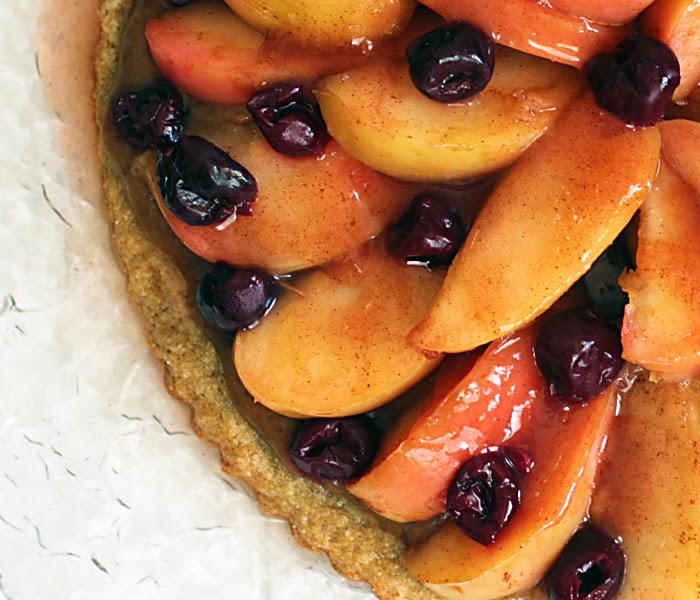
Glazed caramel apple sponge cake with cherries, gluten-free or not


What would be the purpose of reading so many blog posts if no inspiration took place? Isn't that the point? I was inspired to make an apple tart by a post on Seitan is my motor, where Mihl has been tirelessly whipping up one spectacular classic German dessert after another. She made a dessert called Erdbeerboden that had a crust she called sponge cake. But because Erdbeerboden means strawberry cake, mine would be have to be called something else, though I have no idea what that might be — apfelboden? But it also had cherries and dates, so I don't know.


The fragrant, cooling crust, before being removed from the pan.

I had to de-glutenize the crust, but it wasn't hard, and it still seemed springy and spongy to me. I used an 11-inch tart pan with a removable bottom. The sides didn't stick at all, and after loosening the cake from the pan bottom a bit with a knife, the cake released intact from the pan. I completely forgot to line the pan with a circle of parchment, which would have made removal even easier.

For my ingredients I used:
5/8 cup cup hot water
2 tablespoons chia seed
2 tablespoons canola oil
1 teaspoon vanilla extract
1/2 cup sugar
3 tablespoons almond flour
3/4 cup Bob's Red Mill all-purpose gf flour
2 teaspoons baking powder
3/8 cup arrowroot

Grind the chia to a powder in a high-speed blender, then add the hot water and emulsify. Whisk the sugar, two flours, baking powder and arrowroot together in a large bowl. Add the chia-water, oil, and vanilla, and mix with a electric hand mixer (if you have one) until smooth (about one minute).

Place the batter in the tart pan and bake at 400˚F for 15 minutes, or until golden. Let cool on a rack before loosening and removing the cake from the pan.

Now head to Mihl's post for complete directions, and the more traditional, non-gluten-free version.

The caramel sauce spread onto the cooled crust.

On top of my sponge cake, I added a layer of caramel. I was inspired to make caramel sauce from soaked dates to spread on the cake by a post on Keepin' it Kind. I had a bit of trouble with this because the quantity of dates was too small to be adequately blended in either my food processor or my blender, and I ended up adding more liquid to get it smooth. It was a little looser than I wanted, but still worked out OK. I think I might double the quantity next time so as to have a thicker caramel. (The salted caramel sauce was really intended to be part of another recipe for salted caramel apple butter, so it wouldn't have mattered if it were a little lumpy as it would have been thoroughly blended with the apples, later. For my purposes, I needed it smooth.)

The cake before being glazed.

Speaking of the apples, although Kristy's post provided the inspiration to cook the apples in a slow cooker, and combine them with caramel, my first experience with cooking apples and other fruit in a slow cooker was when I tested recipes for Robin Robertson's book, Fresh From the Vegan Slow Cooker. The results were so rich and flavorful that I used my slow cooker for the apples in this recipe with the hope of adding intensity to the flavor. I sort of followed Kristy's no-sugar recipe with a little additional water, but shortened the cooking time, cooking just until the apples were tender but still held their shape. I really love my slow cooker.

After cooking and cooling, the apples were applied to the crust and decorated with cherries. (I used frozen cherries which I heated briefly in a pan to defrost them and release their extra liquid.)

The final piece took me back to Mihl's blog again to make a glaze. I used the liquid left from cooking the apples, the soaking water from the dates and liquid left from cooking the cherries, and a small amount of sugar. I made the glaze using both arrowroot and agar agar flakes because I wanted it to be a little soft, rather than a hard jelly.

For the glaze:
1 cup liquid leftover from cooking apples, soaking dates, warming cherries
Sugar, to taste
5/8 teaspoons agar-agar powder
1 teaspoon arrowroot powder

The glazed cake.

Sweeten the liquid to taste. Sprinkle the agar agar over the cold liquid and let it sit for five minutes. Place the arrowroot in a small dish and add 1 tablespoon liquid. Stir to dissolve, then add to the agar agar mixture. Heat the glaze until it bubbles, turn to simmer, and cook until thickened, about five minutes.

Pour the glaze over the fruit and refrigerate the  cake so the glaze can set.

Then, eat the cake. Thank you Mihl and Kristy.