April 10, 2010

Walnut date confections | black onion seeds

Several days ago I was reading one of my favorite blogs, Chow Vegan, and was taken with the almond-date bars described there. These confections appear with regular frequency on blogs, and it wasn't the recipe per se that sent me running to the kitchen — it was the photo. I wanted to eat it. Of course, that was impractical, so I was forced to actually make the treats. Chow Vegan's (inspired by a recipe on dreaminitvegan) alluring version was made with chopped almonds, dates, coconut and vanilla, shaped into almond-topped bars, and drizzled seductively with melted chocolate. They were quite fetching.

I often used to make stuff like this back in the olden days when I was first learning about whole foods and vegetarianism. I remember having a favorite recipe called bliss balls, which if I'm not mistaken, probably contained non-instant dry milk, the nutritional darling of the moment. I was under the impression that adding milk powder to just about anything boosted its nutritional value. My opinion about milk has changed since then, but combining ground nuts, dried fruit and coconut into chewy sweetmeats is just as delicious as ever, and I love seeing the latest versions on blogs.

I followed Chow Vegan's recipe, except I used walnuts instead of almonds because the only almonds I could find in the pantry were salted, and that was unappealing. I had some raw walnuts (1/2 cup) that I combined in the food processor with soft pitted dates (1/2 cup), unsweetened shredded coconut (1/4 cup) and vanilla (1 teaspoon). Since I wanted to offer these treats to my 2-year-old granddaughter, and her mom prefers that she not eat chocolate, I rolled my treats in coconut. They looked and tasted yummy — to me. Miss E would have none of it. She acted as if I were offering her slimy toads to eat, and refused to try even a morsel. Ah well.

----------------------------------------------------------------------

Kalonji - black onion seeds - nigella sativa

I was the lucky recipient of a bag of black onion seeds sent to me by River, The Crafty Kook, after I read her blog post about Indian food. They are tiny black seeds about the size of sesame seeds that grow on an annual flowering plant (nigella sativa) native to southwest Asia, and are used as a spice. The seeds are used as part of the spice mixture panch puran, and by themselves in many Bengali recipes, especially in Naan Bread. According to Wikipedia, "Nigella sativa has been used for medicinal purposes for centuries, both as a herb and pressed into oil, in Asia, Middle East, and Africa. It has been traditionally used for a variety of conditions and treatments related to respiratory health, stomach and intestinal health, kidney and liver function, circulatory and immune system support, as analgesic, anti-inflammatory, anti-allergic, antioxidants, anticancer, antiviral and for general well-being."


I didn't attempt to cure anyone of anything but hunger when I took some no-knead bread dough from the refrigerator, rolled it into a flatbread, dusted it with seeds, and baked it on a cast iron griddle on the stove. Delicious and very pretty!

----------------------------------------------------------------------

I recently received the following email:

Hi Andrea,
I just published an article on my site, “100 Blogs Leading the Food Revolution.” First, I am happy to let you know that your site has been included in the article and if you have any questions about that article, how your site is described, etc. I wanted to let you know that you should feel free to email me. In addition, I thought I would bring it to your attention in case you think your readers might find it interesting and consequently would consider giving the article a mention on your site.
In any case, thanks for your time!

Best,
Jeanne Peterson
Take a look at the article — you may discover a new blog or two to follow. I'm honored to be included.

April 06, 2010

American chop suey | tangy carrot and cabbage salad

My mother grew up during difficult economic times, and money was tight in her household. I don't know exactly what her diet was like, but I do know she developed an aversion to foods she thought of as the foods one would have to eat if one were poor. She despised foods she thought of as "filler foods" which generally included things like grains or pasta. Pasta was not comfort food to her, it was something you had to eat if you couldn't afford to buy anything else. When we ate at Chinese restaurants, for example, I was told not to fill up on the steamed rice, and when she made things like meatloaf or hamburgers she never added breadcrumbs or other fillers. She added eggs and seasonings.

During the early years of raising a family, my parents didn't have much money. My mother ran the household on a strict and tight no-frills budget. I wore a lot of hand-me-down clothes from my cousins (which I loved, by the way). However, the one thing my mother wouldn't compromise on was her idea of what we should eat. My mother trimmed corners in other areas in order to put meat on the table nearly every night. We had good cuts of meat every evening that my father was home for dinner, and chicken, hamburgers or occasionally fish when he wasn't. My mother favored eye roast, steak, pot roast, chops and such — no spaghetti on our plates. There also was always a fresh salad, and sometimes frozen or canned vegetables. (I didn't even know fresh vegetables existed.) She seldom spent food budget money on soft drinks, chips or other junk food, saving it all for the good stuff. Lucky me, right?

Naturally, all I wanted was noodles, and for that I had to turn to my father. My father was not much of a home-arts kind of guy (this is an understatement in the extreme) but there were a few things he would cook if hounded enough. He could make pizza from scratch (learned from owning an Italian restaurant), grilled chickpeas (learned from his mother), and American chop suey (learned when he was a cook in the army). American chop suey was a mix of ground beef, tomato sauce and macaroni that I believed was something only my father made, and I loved it, though my mother wouldn't touch the stuff. I recently had my memory jolted by a post on Mitten Machen in which Mary provided a description and veganized recipe using tempeh, for this homey dish. What a shock! Naturally, I had to make it as soon as possible, and although I only had linguine instead of the small pasta traditionally used in the recipe, it was fabulously delicious. (Both Mary and I used quinoa pasta for this dish. Ancient Harvest Quinoa pasta has become my husband's and my favorite pasta, and we use it for most of our pasta recipes.) You can see the American chop suey in the photo at the top of this post, and you should visit Mary's blog and make some! Thanks, Mary.

-------------------------------------------------------

As I've been mentioning lately, we've had a bit of company, and our last guest, my brother, left Monday morning. On Sunday evening our son and d-i-l hosted a dinner for the family, and prepared some wonderful food.

Our d-i-l made Jamaican red bean stew (from Robin Robertson's "Quick Fix Vegetarian") in the slow cooker she found at our last Goodwill excursion. It was really great — spicy, fragrant and filling.

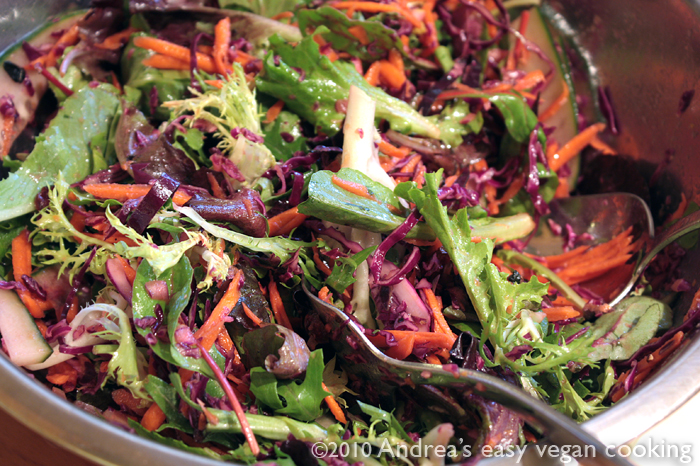
Our son made his excellent version of long beans and tofu. And I brought a salad. I hadn't actually planned to post a recipe so I didn't measure anything, but the salad turned out so well I wanted to share it. It was both beautiful and delicious, and I've reconstructed it as best I can, estimating when I didn't know exact amounts. It's the kind of recipe where a little more or less of one ingredient or another won't make or break the dish — lots of room for improvisation and customizing to your taste!

Tangy carrot and cabbage salad serves 10
  • 3 to 4 large carrots, peeled and coarsely grated
  • 1/2 small purple cabbage, core removed, finely shredded
  • 2 to 3 green onions, cut fine
  • 1/2 to 1 small cucumber, sliced into thin spears (opt. but refreshing)
  • 1/2 cup dried cranberries
  • 5 to 8 ounces mixed baby salad greens
  • 1/4 cup extra virgin olive oil
  • zest and juice from 1 lemon
  • 1 tablespoon dijon mustard
  • 1 to 3 teaspoons umeboshi vinegar (to taste)
  • 1 to 3 teaspoons agave syrup or other sweetener (to taste)
  • fresh ground black pepper and salt (if needed)
  1. One to two hours ahead, prepare the carrots, cabbage, onions and cucumbers. (The cabbage should be halved lengthwise, leaving you with two identical halves. You will only need one half.) Place the carrots, cabbage, green onions, cranberries and cucumbers into a large bowl and combine.
  2. Make a dressing from the oil, lemon juice and zest, mustard, vinegar and agave. Mix until smooth, then mix the dressing into the vegetables. Marinate in the refrigerator for 1 to 2 hours.
  3. Just before serving, add a few grinds of black pepper to the slaw mix and stir in. Taste for seasonings and adjust if necessary.
  4. Add the fresh salad greens to the bowl and carefully but thoroughly mix the salad together.

April 01, 2010

Guest fest

My Passover dinner plate

I am so tired. We've had company all week with no time to blog or even read blogs. But that's not the source of my fatigue ... no, I've got some sort of stomach bug that's getting me down. At least it hit at the end of the week. Though with more company coming tonight, I hope it doesn't linger too much longer.

We've been busy entertaining my husband's mother and sister, who traveled here from the East Coast to spend a week with us in the Pacific Northwest. We've done a bit of sightseeing and hanging out.

Monday was the first night of Passover, and we celebrated with a family Seder. There were 11 of us around the table, and after the service, we enjoyed a festive meal prepared by two of my sons and me. We had matzoh ball soup, roasted asparagus, potato stuffing, chickpea croquettes, cranberry-apple sauce, salad, and carrot-coconut macaroons.

This was the ceremonial Seder plate with a couple of vegan substitutions. There was an avocado instead of an egg, and a roasted beet subbing for the lamb bone.

Here we are reading from our Haggadot, or Passover prayer books. Mr. Easy Vegan conducted the service and we all took turns reading. Lest you think we are very religious, we're not. But I love maintaining some of the rituals I grew up with, and which tie us to our history.

Here is my youngest son and his girlfriend, attending her first Passover Seder.

One of the things we did during our family's visit was to take a ferry ride to Bainbridge Island, and you can see the Seattle waterfront and skyline as we pulled away from the dock. It was kind of sunny and pleasant, and I was really hoping we would have a clear view of the mountains as we headed towards our destination, but it wasn't quite clear enough. We spent a pleasant afternoon wandering around the Bainbridge Island downtown, poking into stores and having tea.

Tuesday evening we went to a vegan Chinese restaurant, and there were so many of us that they put us into a private room with a huge round table. I really enjoyed the dinner, and all was well until I went to bed, and started to experience stomach distress that kept me awake most of the night. The next morning I had tea instead of breakfast, and at the point where everyone headed out for a walk at the lake, I headed up to bed. Later, as our guests enjoyed a tour of the Theo chocolate factory, I alternated between hurling, the big D, and sleeping. I made a brief appearance before dinner, but once they began to eat, I headed back to bed. I managed to consume a banana and drink water, but that was it. I feel a lot better today but my stomach is still not happy.

So with all the sightseeing and pleasant outings, what was the most entertaining aspect of the visit? I think our guests would agree that the always cheerful and ebullient Miss E wins hands down.

Except for the stomach bug, it was a pleasant week. My brother arrives this evening for round two of guest fest. I hope I feel better soon!

For all those celebrating Easter, I wish you a happy holiday!