June 27, 2016

Mesquite BBQ salt and more


Some time ago I was offered samples of 'bacon' bits made from beans, but I ignored the offer, as I often do when companies want me to review their products. Then I read a rave review of the beans on Vegan Eats and Treats, and I had a moment of doubt about my prior decision. So, I looked up the tossed aside email, and wrote back saying I'd be happy to review the bean bacon if it wasn't too late. The sender wrote back saying not only was he sending beans, he was also sending gluten-free ice cream cones, chips and salt. I planned to write back and say only the beans, please,  but didn't get around to it. (Not good timing for chips and ice cream cones when I'm trying to eliminate extracted oils and cut way back on sugar and salt.) I forgot all about it until boxes started arriving at my door. I didn't receive any bacon made from beans, but I did get three other boxes, including a box full of Pacific sea salt. The salt comes from New Zealand. "It is harvested from the pristine waters of the great southern oceans. Currents sweep up the Southern East Coast of New Zealand and into the solar salt field at the top of the South Island. The seawater is evaporated by the natural process Of sun and wind for 13 to 22 months. At the end of each summer, Pacific Sea salt is carefully gathered to retain the balance of minerals and trace elements naturally present in sea salt."


As you can see in the first photo, I received five samples — all of which I will use. So far I've only sampled the three small bottles, and all three seem excellent. In line with our oil-avoidance, we found at a resale shop, an Orville Redenbacher air popper for $3.00, which seems to be in perfect, like-new condition. The salt arrived just in time to sprinkle on our first batch, and both the barbecue and the mesquite flavors were delicious. It didn't take very much of the very fine salt to give the popped corn a delectable flavor. The smoky mesquite was my favorite, but the chipotle is excellent, too. They both will be terrific to use for cooking either on the grill, or on the stove.

The third bottle, flake salt, is a gourmet item. The description on the bottle says, "Marlborough Flaky Sea Salt has been specially evaporated to produce a unique flake shaped salt crystal prized for its enhanced natural flavor and soft texture. This makes it ideal for garnishing all your favorite dishes." It does seem to have a richer flavor than plain salt. I'm very pleased with the Pacific salts and am happy to recommend them. In fact, I think I'll have to re-buy the mesquite and the chipotle when they're gone. Have you tried any of the Pacific Sea Salts or other specialty salts?


I probably shouldn't be including the photo above since it detracts from the serious intention of my review, but I can't help myself. When I walked into the kitchen, this is what I saw. My husband had set the new popper on the counter next to the dog dish, which hadn't yet  been given to the dog. When I saw the two together, I couldn't help but take a photo. It's a pretty special popper, don't you think?

Disclaimer:
I received free product. I wasn't paid. All opinions are my own.

June 20, 2016

Crock pot soup — no oil, big taste


In my last post I mentioned I took the ferry to Port Townsend to attend a meeting of the Port Townsend Vegan Meetup Group, because they were hosting a talk by Dr. Michael Klaper. I've never heard Dr. Klaper speak before, and was, in fact, unfamiliar with his work other than knowing he advocated a no-oil, vegan, whole foods lifestyle as a way to maintain or regain health. He also says sugar should be used as a favoring agent, not a food. His 'talk' turned out to be a 3-1/2 hour class on becoming healthier through diet. He addressed many health issues, from the reasons people struggle to lose weight, to the connections between diet and ailments like rheumatoid arthritis, leaky gut and heart disease. He also incorporated animal rights into his talk. Dr. Klaper is such a genuine, compassionate, intellegent, knowledgeable and humorous speaker, his talk went by in a flash. And I was inspired to incorporate his ideas into my daily meals. (At the end of the post, I'll provide a link to the talk I listened to so you can hear it, too.) I don't know if I can keep it up, but I've managed to follow his suggestions for a little more than a week. (It will be kind of impossible for me to do when eating out because I don't have the kind of resolve that Dr. Klaper has. He suggests eating before you go, and ordering a plain salad or soup. Not there, yet. I was out to dinner with the family last night and ordered lentil soup and dolmas, which was exactly what I wanted — but I could tell the dolmas, at least, were pretty oily.)

I've never been able (or willing) to remove extracted oils from my diet, and, in fact, thought it was kind of overkill, but I'm reconsidering. I know people who have followed Dr. John McDougall's similar no-oil diet for years, and they love it. One of them started following it because she has MS, and she went into remission. I've been making no-oil dishes lately, but I will probably be posting both my experiments with no-added-oil foods as well as the usual choices.

Dr. Klaper suggested eating very large salads for lunch and using the slow cooker to make soups that last for a few days. He really does love soup! I followed his lead with a couple of slow-cooker creations. I have to admit when I read a recipe that has tons of ingredients, my interest starts to dwindle. But, when I'm making something up on the fly, adding a load of ingredients seems easy. The soup took about a half hour to prep, using ingredients I had on hand. I steamed the broccoli separately and added it at the end because cooking broccoli in a soup isn't as good-tasting as adding it just before serving. Although the ingredients look pretty basic, the soup surprised me with its rich, delicious flavor. Even my husband, who thought not sauteing the veggies in oil would ruin the taste, loved it.


This is what I piled into my six quart crock pot:
  • 2 medium onions, chopped
  • 3 large cloves of garlic, peeled and thinly sliced
  • 3 or 4 large carrots, peeled, cut into 2-inch pieces, then sliced lengthwise
  • 1/2 small cauliflower, roughly chopped
  • 2 medium potatoes, 1/2-inch dice
  • 1 can of low-sodium black beans (or other beans), drained and rinsed
  • 1 can chopped tomatoes
  • 1/4 cup dried red lentils, rinsed and drained (I learned this broth-enhancing trick from Isa Chandra Moskowitz's cook books)
  • 1/3 to 1/2 cup nutritional yeast flakes ('nooch') (You won't taste it in the end.)
  • 1 quart low sodium soup stock (can use water instead)
  • enough water to fill the pot to the cooking line
  • 1 teaspoon chipotle chile powder (for non-spicy soup, use 1 teaspoon smoked paprika or 1 teaspoon paprika plus 1/2 to 1 teaspoon liquid smoke)
  • 1/2 teaspoon salt (or to taste)
  • juice of 1/2 to 1 small lemon (to taste) 
  • two cups of chopped broccoli (about one large stalk), steamed (in a bamboo steamer, if you have one.)
  • fresh or dried herbs as desired (I used fresh oregano and thyme from my garden, but parsley, basil, rosemary or cilantro also would be good.)
  1. Add the onions, garlic, carrots, cauliflower, potatoes,  beans, tomatoes, lentils, yeast flakes, stock and water to a six-quart crock pot.
  2. Stir in the chipotle chile powder (or paprika and liquid smoke).
  3. Cook on high for four hours, then low for one to two more hours, until veggies are tender.
  4. Steam the broccoli and add to the pot. Stir in salt, lemon juice and herbs.
  5. Taste for seasonings, Eat.
We served our soup over a small amount of brown rice.

Here is the link to Dr. Klaper's talk, should you wish to listen.  There is a brief introduction by one of the PT Meetup organizers, before Dr. Klaper's talk.

June 14, 2016

Five-spice chickpea noodle bowl revisited plus other random edibles

Five-spice chickpea peanut noodle bowl.

In my last post — a review of Protein Ninja by Terry Hope Romero — I said I loved one of the recipes so much I was going to re-make it to bring as my contribution to a dinner at a friend's house. Well, I did just that on Saturday, and it was fantastic. I made a couple of changes to make it more of a salad than a bowl,  but basically it was the same. Instead of four to six ounces of long rice noodles, I used about 12 ounces of fusili, I added an extra half can of chickpeas, and possibly there was a bit more shredded cabbage. And I had way too much! After filling my large serving bowl about 1/2 full, I packed the rest away in the refrigerator to use for lunches and dinners!

Rather than wait until the last minute to make the salad, I prepared the components in the morning to be  assembled before leaving for the party at 4:30. While the chickpeas were roasting, I prepped the veggies, boiled water and cooked the noodles, and made the peanut sauce. I kept the parts separate until it was almost time to leave, then mixed all into a beautiful salad. Such a great dish!

On Sunday we took the ferry to Port Townsend to attend a lecture by Dr. Michael Klaper. I was inspired to try eating a little differently than usual, and I'll share the foods I've tried (amazingly delicious) in my next post, but I'd better post my saved random eats photos now, just in case Dr. Klaper has a lasting impact on my diet, and my photos no longer reflect my eating style. I suspect things will probably not change much, but you never know.


What you are looking at is my modern-day version of a gluten-free (or not) bannock, as might have been consumed during the 1700s in Scotland. (As an Outlander fan, I felt the need to make these one day.) My bannock, in this case, is filled with barbecued tempeh — not very 18th century Scottish, I know. The bannock recipe I concocted appeared on the blog, here. I received a letter from a reader not long ago saying she tried making the bannocks, and the recipe failed, so I immediately got to work making some. I tried the recipe twice, and it worked both times, but so many things can vary with baking ingredients, it's impossible to guarantee perfect results. I should ask my husband to make them, and watch to see if there's anything I can do to make the recipe better.


My husband made this, and after tasting one bite I said, "whoa, this is amazing!" Turns out he made ye'atakilt alicha from Teff Love by Kittee Berns. He tricked me by serving it with rice instead of injera. I had just read a blog post by Kittee and had been wishing for Ethiopian food, so it was perfect timing. If you don't own Teff Love, you should go buy it right now.


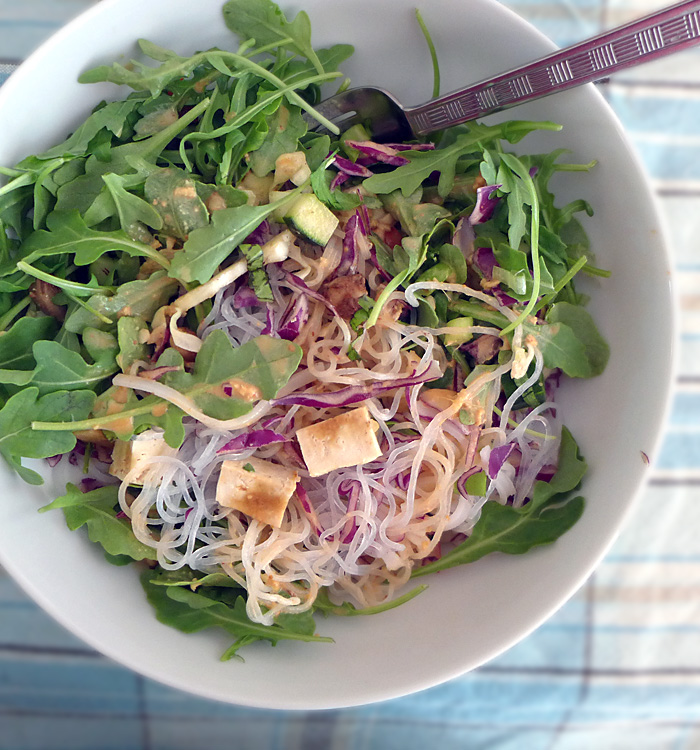
I do love my noodle bowls. This one has shredded red cabbage, cucumber, arugula, green onion, and microwaved extra firm tofu with Bragg's.


I'm getting pretty good at turning leftover stir-fries, stews, or whatever into burgers. These contained a lentil and rice dish (mostly rice and very dry lentils), leftover veggies (I think cauliflower and carrots), hemp seeds, garbanzo flour, herbs and spices, dried onion and garlic, and a bit of water and tomato for processing. Zip zip in the food processor, mold into patties and cook in a pan on the stove top or in the oven. They were great hot for lunch, and the leftover cold ones made delicious sandwiches to take on out ferry trip to Port Townsend. No recipe needed. Do you like to experiment and cook without recipes? Have you had a favorite success?


Last but not least, this is one of my typical breakfast bowls, with homemade yogurt, blueberries, o's, hemp seeds and raisins. And there's also a banana buried in there!

This post contains Amazon links to books I recommend.