Showing posts with label tahini. Show all posts

March 18, 2015

Millet madness — millet bowls and millet burgers

Babysitting is fun.

We recently did a whole bunch of baby sitting for our grandkids while their Papa was out of town and their Mama had to play cello in the orchestra for a multi-night high school theater production at the school where she teaches music. One of our "duties" was to attend a talent show sponsored by Miss E's elementary school. Miss E is seven years old, and she is now brave enough to appear on a stage and perform.

The concert had a number of singers, a guitar soloist, lots of dancers, a couple of cheerleaders, and a hula hoop demonstration performed by Miss E and two friends. I'm not saying hula hooping isn't a talent — it certainly is — and we and the rest of the audience were exceedingly entertained by the performance, but something about it triggered an old memory of a performance her papa gave when he was about six.

He was a Suzuki violin student at the University of Wisconsin School of Music, and the recitals we attended for all the children from the youngest to the most accomplished, were impressive. They took place in a beautiful, small concert hall at the school of music. At the time he was learning violin, he was also obsessed with playing harmonica, and asked me if I thought he could play his harmonica at the violin recital. I didn't think so, but told him to ask his teacher, and the lovely Mary Beth Cullitan, after hesitating just a moment, said yes. Her goal was to encourage a love of music in whatever form it presented itself. So, at some point during the recital of classical string music, future-papa brought down the house with a polished and rousing harmonica rendition of Old Joe Clark. It was a weirdly thrilling parenting moment that I'll never forget.

Roasted carrots and chickpeas plus kale and tahini-umeboshi sauce over millet.

I love when a current happening unearths an old treasured memory, and I get to enjoy it again. It's a little like when a recent event, in this case a trip to San Francisco and Santa Cruz, inspires a string of cooking choices that play on memories, and become new favorites, reminding me in turn of the source of their inspiration. We were recently in Santa Cruz and I loved the lunch bowl I had at Café Gratitude so much I couldn't stop thinking about it. The grain in the bowl was millet, and I've become a little obsessed with millet, as you will see. Millet tends to be an overlooked food here, and in fact, most millet grown in the U.S. is grown for bird seed. Millet comes from a group of seeded grasses and is widely used for food in arid and semi-arid areas of the world. I like it a lot.


When we returned home from our trip, I made a millet bowl with roasted carrots and chickpeas, plus kale, topped with green onions and tahini sauce.It was so good it was shortly followed by a similar bowl with sweet potatoes, black beans and kale. The kale for the bowl partly came from a leftover deli container of PCC emerald city salad. There was just a tiny bit of salad left so I added a bunch more green onion and chopped kale to the container, mixed it with the remains, and used it for my bowl. I also warmed it up. Although the emerald city salad is meant to be served raw and cold, it also makes a great warm salad.


When I made the millet bowl, I made extra millet because I wanted to make millet burgers. Millet has a chewy texture that seems just right as a base for burgers, and the patties were wonderful. I wish I had written down a recipe, but I was using up leftovers that were in the refrigerator, adding spices like a mad scientist, and I have no precise memory of what went into the burgers. I think there were a couple of carrots, a few mushrooms, a bit of leftover kale, some chickpeas, perhaps some ground flax seed, half an onion, and other stuff I can't remember. The burgers were browned on the stove, then baked. This is the way I prefer to cook — without recipes — but then when something turns out well, sometimes I wish I could make it again.

Do you ever cook with millet? I've read both pros and cons about its nutritional value, but I guess that's true of most foods these days. Sigh.


October 12, 2012

Umeboshi-tahini dressing | First time in an art show

Today's memory comes from when I was in my early 20s and living in Syracuse, NY. I was doing a lot of painting at the time, and had created a three-foot by three-foot abstract painting I called Nude in a Garden, that I liked a lot. I had a friend — an artist who also taught art in a public school — who told me I should enter my painting in the Everson Museum Invitational, a juried exhibit that attracted entries from around the country. My first reaction was negative — I was very shy about showing my art, and this was way too public. No, no, no. But she kept harassing me, and I finally relented and dragged the painting down to the museum. Ugh. I was prepared only for rejection, so when the notice came that my painting had been accepted, I was shocked. Could barely breathe. I called my friend to see if she'd gotten her acceptance, but she hadn't. And she didn't. She and all her artist friends had entered, and only I, a casual artist at best, got in. Well.

The evening of the opening arrived and my husband and I went to the museum. I was a little shaky, but excited. We wandered the rooms until I caught sight of my painting, and it was too much. I couldn't enter the space. I glanced at my body to make sure I was wearing clothes, because I felt so naked and exposed. I hated the painting that I had previously liked so much — it was hung badly, it clashed with the paintings on either side, the colors looked bad, the frame was wrong, etc. etc. etc. I just couldn't wait for the show to be over so I could get the painting back home. Horrible.

My attitude toward seeing my work in public has never improved, and I reacted the same way to seeing my things in other shows, even in ones where I received an award. I've even gone to a show with a friend and refused to tell her which piece was mine. I thought I was singularly neurotic until I went with a highly creative co-worker to an art show in which he had two pieces, and he refused to tell me which ones they were! I couldn't believe it, but we had a good laugh over our shared problem, and he finally relented. His paintings were amazing, but he saw only catastrophe instead of art.

It's been a long time since I've put my personal art in public. As a graphic designer, my designs were very public, but no one knew they were mine. I liked the anonymity.

Today's recipe is umeboshi-tahini dressing. I've been putting this stuff on my grains, beans and salads for so long I don't even think of it as a recipe. In fact, I never measure the ingredients, but I did so I could post a recipe. I learned to make it when I followed a macrobiotic diet, and I never stopped using it. It tastes so good and adds a special tang to whatever food it's applied to. Salad dressings can be very anonymous, but this one stands out and refuses to be overlooked.

Some people get annoyed when they see "weird" ingredients like "umeboshi paste" listed in a recipe. It sounds so exotic and obscure. But is using Japanese umeboshi plums really so different from using all the other wonderful foods and condiments we've adopted from other countries? It's just another powerful flavor source that's good for your health as well as your palate. Look at all the Mexican foods like chipotle in adobo, or salsa verde, or Middle Eastern foods like hummus, felafel or tabooli. At one time they were considered exotic and strange.

Umeboshi plums and paste are made from a very small, round fruit closely related to the apricot, that is pickled with salt and shiso leaves. You can buy them whole or as a more convenient-to-use paste. It may seem expensive but it goes a long way, and I don't buy it very often. It has a salty-sour taste that goes especially well with the bitter flavor of tahini.

Umeboshi-tahini dressing
  • 1 teaspoon umeboshi paste
  • 1 generous tablespoon tahini
  • 1 tablespoon lemon juice
  • 1 teaspoon agave syrup, maple syrup or other sweetener of choice
  • 1 tablespoon water to start, plus more as needed
Place the umeboshi, tahini, lemon juice, sweetener and water in a small dish or measuring cup. Mix to a smooth consistency. Add more water, a little at a time, as necessary to achieve a creamy dressing that is thick but will drizzle from a spoon. The amount of water depends on the texture of your tahini.

I don't usually sweeten the dressing when it's going to be used on beans or grains, only when it's destined for a green salad — and not always even then. And I don't always add lemon — just tahini, umeboshi and water.

oooooooooooooooooooooooooooooooooooooooooooooooooooooooo

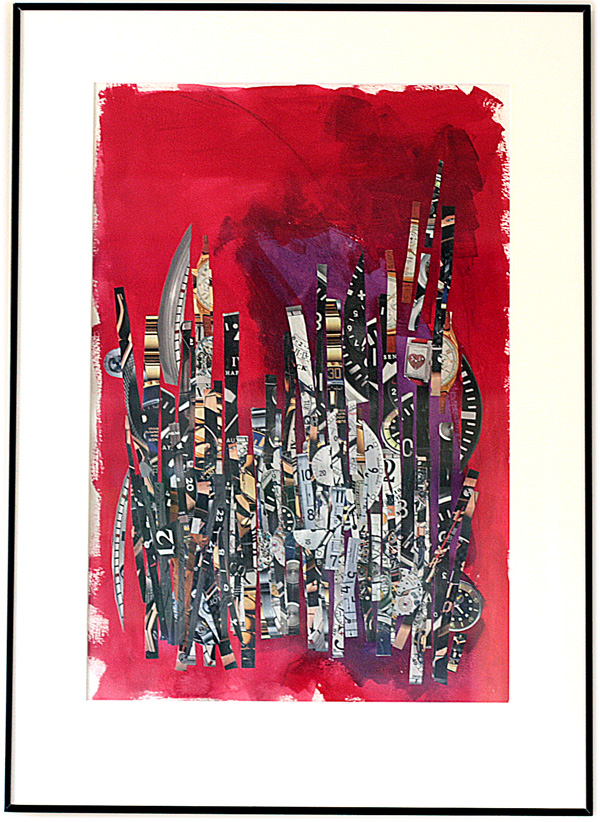
Most current piece - "It's About Time" - collage with acrylic paint
"Quilt" - colored pencil, acrylic, pen

Watercolor painting for garden journal

Painted bird house
Acrylic painting from an album photo

March 11, 2010

Eggplant salad with ume-tahini dressing

The salad as served on an 8" plate to company.
We recently had friends come for dinner and I planned an Asian-inspired meal with seitan and broccolini in a sweet and sour sauce over rice. I wanted to have a salad first, even though raw vegetables aren't usually found on Asian menus. I wanted the salad to have some connection to the main course so I looked through a Japanese cookbook, and found a recipe for eggplant salad — just eggplant, no greens. It had a dressing similar to one I used to make when I was following a macrobiotic diet and I was using many traditional Japanese condiments, like umeboshi. I decided to pan-grill (in a regular cast iron pan since I don't have a grill pan) the eggplant and serve it at room temperature on top of salad greens, with a umeboshi-tahini dressing and toasted sunflower seeds.


Some people blanch when they see "weird" ingredients like "umeboshi paste" listed in a recipe. It sounds so exotic and obscure. But is using umeboshi really so different from using all the other wonderful foods and condiments we've adopted from other countries? It's just another powerful flavor source that's good for your health as well as your palate. Look at all the Mexican foods like chipotle in adobo, or salsa verde, or Middle Eastern foods like felafel or tabooli. At one time they were considered exotic and strange.

The dressing.
Umeboshi plums and paste are made from a very small, round fruit closely related to the apricot, that is pickled with salt and shiso leaves. You can buy them whole or as a more convenient-to-use paste. It may seem expensive but it goes a long way, and I don't buy it very often. It has a salty-sour taste that goes especially well with the bitter flavor of tahini. (I even have a fabulous recipe for tofu cream cheese that uses umeboshi and tahini.)

The eggplant was cubed, soaked, patted dry, pan-grilled and cooled to room temperature before hitting the greens. The dressing was drizzled over all, and the salad was topped with toasted sunflower seeds. (I'm going to put in a plug for the Bob's Red Mill sunflower seeds I recently purchased. Maybe I was just lucky but these are the smallest, freshest, sweetest sunflower seeds I've ever bought. They're delicious raw or toasted and I love them.) I made enough salad for four people but the ingredients are flexible so use whatever quantities you wish. The dressing is very flavorful and goes a long way, but if you like your salad loaded with dressing or want leftovers, you can easily double the recipe.

The salad (missing carrots) served in a big bowl to me for lunch.
Eggplant salad with umeboshi-tahini dressing
  • 1/2 medium eggplant (cut the whole eggplant in half lengthwise)
  • avocado or olive oil
  • salad greens
  • 2 carrots, peeled and cut into thin sticks
  • 1/2 cup sunflower seeds, toasted in a pan
  • 1 teaspoon umeboshi paste
  • 1 tablespoon tahini
  • 1 tablespoon lemon juice
  • 1 teaspoon agave syrup or maple syrup or 1-1/2 teaspoons brown rice syrup
  • 1 tablespoon water, more if needed
  1. Cut two 1/2" thick steaks from the eggplant half. Cut each steak into 1/2" cubes and soak the cubes in water for 10 minutes. This is supposed to get rid of bitterness. Drain the eggplant and pat dry with paper towels.
  2. Place about 1 tablespoon of oil into a cast iron (or other heavy) pan and heat. Add the eggplant and brown on one side over medium heat about five minutes. Turn and brown the other side. Remove eggplant to a plate and let cool to room temperature while you make the dressing.
  3. Place the umeboshi, tahini, lemon juice, sweetener and water in a small dish or measuring cup. Mix to a smooth and creamy consistency. Add more water if necessary to achieve a creamy dressing that will drizzle from a spoon. The amount of water depends on the texture of your tahini.
  4. Toast the sunflower seeds.
  5. Place the salad greens on four individual plates or bowls. Divide the eggplant into equal portions and mound in the center of the greens. Artfully arrange the carrots. Drizzle dressing over all. Top with sunflower seeds.
..........................................................

Day-glo bread and other misc. stuff

Here's a bread to which I added turmeric to give it a golden hue (and because it's supposed to have so many health benefits). It actually came out a lot more golden than I expected, and looks kind of weird. (I haven't photographed the inside but believe me, it's BRIGHT.) It tastes good, though. It's got rye flour in the dough for a little extra flavor, and sesame seeds on top.

I've been making English muffins from my no-knead bread dough, and having sandwiches for breakfast. I'm trying to eat more in the early part of the day and less at night, and these hearty breakfasts seem to really stick with me. I've found that a thinner muffin bakes up more successfully so pat your dough to no more than 1/2" thick. This particular sandwich had a veggie burger, avocado, English cucumber and Russian dressing. Just looking at it now gives me hunger pangs. I've also had muffins with cannelini beans, avocado and salad greens. My current vat of day-glo no-knead dough seems a little too wet for successful English muffin making, so I'm using it for regular loaves. The muffin above was made with the previous batch of dough, which explains its normal hue.


This is kablooey — a tester recipe for Celine and Joni. It is kind of like tabooli but made with buckwheat.